
 EN
EN DE
DE IT
IT FR
FR ES
ES RU
RU JP
JP RO
RO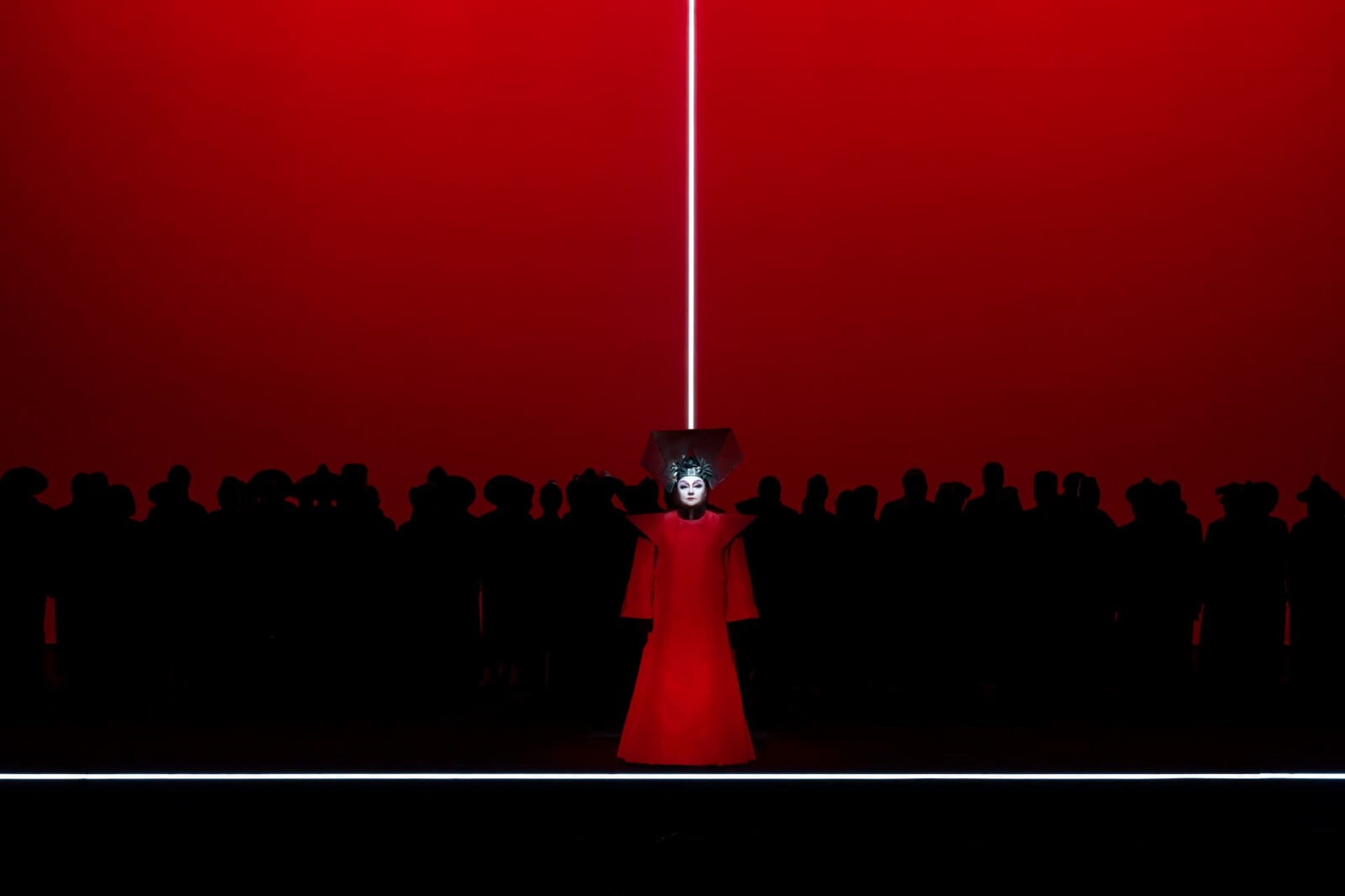
© Charles Duprat / OnP
Turandot
Order tickets
November 2026  | ||||||
|---|---|---|---|---|---|---|
Mo | Tu | We | Th | Fr | Sa | Su |
The Premium Category offers an exclusive experience, including:
The best available seats within the Optima Category
A contribution in support of the Opera
A program of the event
A glass of champagne
Synopsis
First part
Act 1:
A SQUARE BEFORE THE PALACE OF TURANDOT IN PEKING
A mandarin tells the crowd of the decree according to which Princess Turandot will marry the man, who, born of royal blood, succeeds in solving the three riddles which she puts to him. Anyone who fails is decapitated. The Prince of Persia, like so many before him, has not been able to find the solution to these riddles. He will therefore be executed. The guards endeavour to keep back the overexcited throng and in the crush an old man is thrown to the ground and would be trampled underfoot if it were not for the young girl who is accompanying him, who manages to protect him. A young man cornes forward to help them and recognises the old man as his father, Timur, the dethroned Tartar king. Calaf then hears how Timur has fled his country and owes his salvation to Liù, a slave girl, who has devoted herself to him through love for the prince, who once smiled upon her. Ali three decide to continue to remain in hiding.
The bloody rite cannot be accomplished before the moon rises. As it does the crowd becomes elated and the victim appears. The prince is so young and so handsome that the mood of populace changes and they beg for mercy. Turandot appears, silences thecrowd with a gesture and orders the execution. This brief vision is enough for Calaf to fall hopelessly in love. Despite Timur's entreaties, he advances towards the gong which must be sounded three times to announce that a new prince is ready to face the test. The three ministers, Ping, Pang and Pong remind him of the vanity of love and the sweetness of life. Liù reminds him with humility of her love for him, but nothing can persuade him. Calaf rushes upon the gong and it sounds the fatal three times.
Act 2:
FIRST SCENE: THE KITCHEN IN THE PALACE
Ping, Pang and Pong are making the symbolic preparation with the two possible hypotheses in view: a wedding or another execution. They evoke Turandot's riddles and her victims in a half-tragic, half-comic tone. They start to dream of a happy outcome, of Turandot in love at last, and of a return of peace to the country.
SECOND SCENE: THE TOMB OF LO-OU-LING
The Emperor, Turandot's father, tries to dissuade Calaf and expresses the aversion he feels for these repeated sacrifices. But Calaf is unbending. Turandot then appears. She explains at length the reasons for the bloody practice: a female ancestor of hers was once abducted and raped by a foreign prince, who devastated the realm. It is to avenge herself that Turandot has sworn never to love, never to give herself to a man and to see all those who try to conquer her perish. She exhorts the unknown prince to withdraw. Calaf refuses. Turandot then poses the first riddle: « In the darkness ofthe night, a phantom spreads his wings over humanity. All invoke him, ail implore him.
But the phantom disappears with the dawn to be reborn in the hearts of men. Each night, he is born, and each day he dies ». Calaf finds the answer: « Hope ». This answer is confirmed by the sages who hold the rolls of truth. Turandot then pronounces the second riddle: « lt quivers like a flame, but it is not a flame. Sometimes ardent, sometimes languid, it turns cold when one dies but flares up when one dreams of conquest ». Calaf hesitates, then finds the answer: « Blood». The sages give their confirmation. Turandot is troubled and the crowd rejoices. The princess pronounces the last riddle: « What is the ice that inflames you, but becomes icier still before your flame? ».
Calaf would seem to be lost and Turandot exults, but the prince takes a grip of himself and gives the third answer: « Turandot ». The crowd is mad with joy, but Turandot begs her father to free her from her oath and not to deliver her up to the unknown prince. The Emperor is unbending, but Calaf himself cornes to the princess's aid. He proposes a single riddle: to discover who he is before dawn. If she can discover the answer, he will die,otherwise, she will be his.
Second part
Act 3:
FIRST SCENE: THE PEOPLE'S QUARTER
No one can sleep this night. Across the city can be heard the echo of the proclamations made in the name of the princess, who is seeking to discover the identity of the unknown prince. Ping, Pang and Pong inform Calaf that torture and terror reign. The three ministers try to drag his secret out of him.
Timur and Liù are brought in. They have been seen speaking with the prince and are suspected of complicity. The old man is ill-treated, but Liù affirms that she alone knows the secret. The two women confront each other. Manhandled and tortured, Liù keeps her secret and replies to Turandot, who asks her from where she derives her strength, « from love». The young slave girl assures the princess that one day she too will be moved by love, then, seizing a dagger, she kills herself, so as to be sure not to betray Calaf.
SECOND SCENE: A ROOM IN THE PALACE
Calaf throws himself at Turandot. The princess's resistance gradually weakens. Calaf, who is now sure of victory, reveals his name to her just before the breaking of the dawn. He thus puts his life in Turandot's hands. She calls for the people to assemble. The crowd awaits Turandot's announcement. She declares that she knows the name of the stranger: « his name is Love ». The crowd breaks out into a jubilant chorus, celebrating the power of love...
CHARACTERS
Turandot: Princess of China
Altoum: Emperor of China, her father
Timur: Exiled king of Tartary
Calaf: The “unknown prince”, his son
Liù: Slave girl, Timur’s guide
Ping: Grand Chancellor of China
Pang: Grand Master of provisions
Pong: Grand Master of the Imperial kitchens
Program and cast
Opera in three acts and five scenes (1926)
After Carlo Gozzi La Fiaba cinese teatrale tragicomica
Language : Italian
Surtitle : French / English
Duration : 2h40 with 1 interval
First part: 80 min
Intermission: 30 min
Second part: 50 min
Creative team
Giacomo Puccini: Music(1858 -1924)
Giuseppe Adami: Libretto
Renato Simoni: Libretto
Eun Sun Kim: Conductor
Alessandro Di Stefano: Chorus master
Robert Wilson: Director, set and lighting design
Nicola Panzer: Co-stage director
Stephanie Engeln: Set design
Jacques Reynaud: Costume design
Manu Halligan: Make-up
John Torres: Lighting design
Tomek Jeziorski: Video
José Enrique Macián: Dramaturgy
Cast
Elza van den Heever: Turandot(27 Nov. > 12 Dec.)
Anna Pirozzi: Turandot(15 > 27 Dec.)
Yusif Eyvazov: Calaf
Adriana Gonzalez: Liù(27 Nov. > 12 Dec.)
Gabriella Reyes: Liù(15 > 27 Dec.)
Carlo Bosi: Altoum
Alexander Tsymbalyuk: Timur
Biagio Pizzuti: Ping
Bergsvein Toverud: Pang
Manase Latu: Pong
Christian Rodrigue Moungoungou: Un mandarino
Taesung Lee: Il Principe di Persia
Liliana Faraon: Due ancelle
Isabelle Wnorowska-Pluchart: Due ancelle
The Paris Opera Orchestra and Chorus
ADO / Paris Opera's Youth Choir
A coproduction with the Teatro Real, Madrid, the Lithuanian national Opera and Ballet, Vilnius, the Canadian Opera Company, Toronto, the Houston Grand Opera, Houston
Photo gallery

© Charles Duprat / OnP
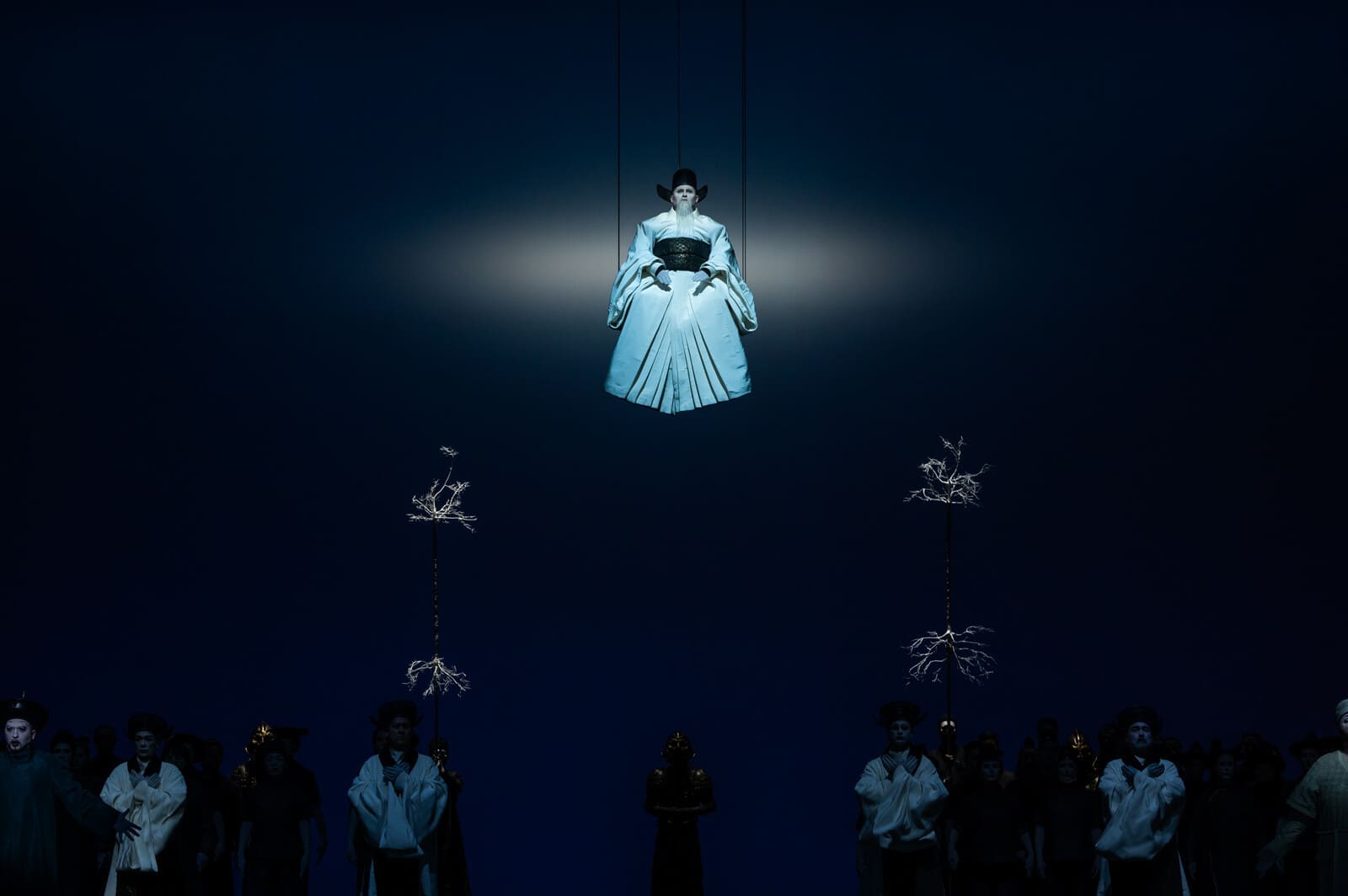
© Charles Duprat / OnP
Paris Opera Bastille
RM Europa Ticket GmbH is an officially accredited ticket reseller of/by Opera National de Paris.
Agency number: 4848428
Opéra Bastille
A great modern theatre
The Opéra Bastille is the work of the Canadian-Uruguayan architect Carlos Ott, who was chosen in November 1983 after an international competition that attracted entries from some 1,700 architects. The theatre was inaugurated on July 13th 1989.
Its architecture is marked by transparent façades and by the use of identical materials for both the interiors and the exteriors.
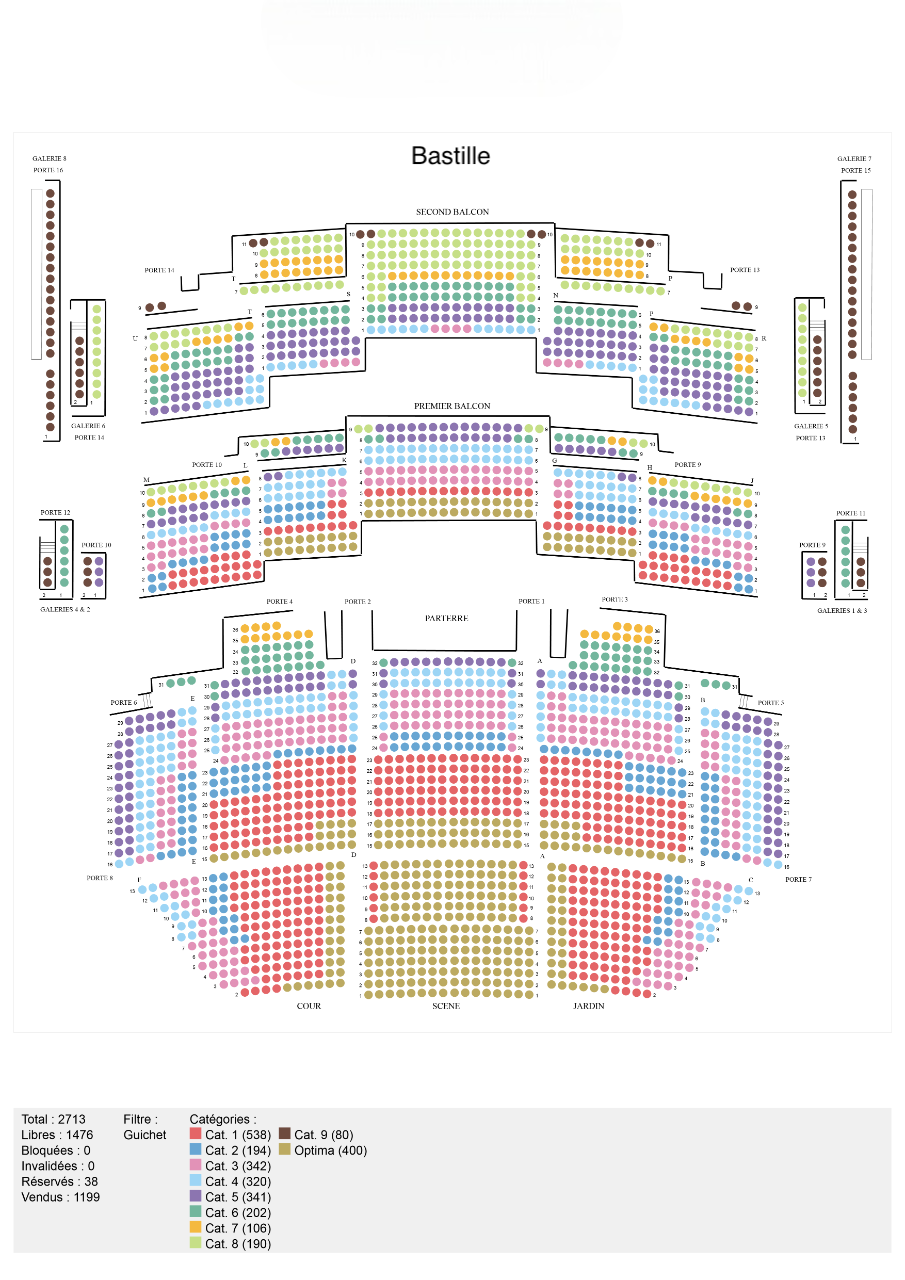
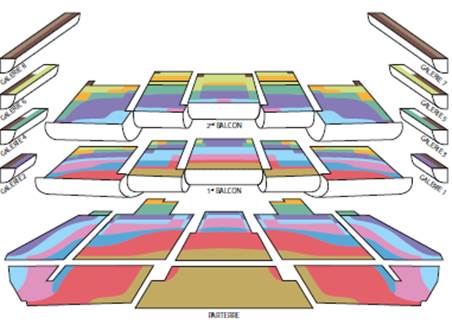
With its 2,700 acoustically consistent seats, its unique stage facilities, its integrated scenery, costume and accessory workshops, as well as its numerous work areas and rehearsal rooms, the Opera Bastille is a great modern theatre.
Stage facilities
Orchestra pit, mobile and adjustable, can be covered; at its largest it can house 130 musicians
Main stage, 45 m high, 30 m wide, 25 m deep, made up of 9 elevators allowing several levels to be created and supported by three main elevators, which bring scenery up from below stage
Clearing zones, 4 storage areas with the same dimensions as the stage
Backstage area, with its scenery turntable
Circulation area, scenery temporarily stored between the stage, workshops and rehearsal stage
Rehearsal stage, the Salle Gounod, with its orchestra pit and dimensions identical to those of the main stage
The building
Area at ground level: 22,000 m²
Floor area: 160,000 m²
Total height: 80 m (including 30 m below street level)
The auditoriums
The main auditorium
Area: 1,200 m², 5% of the total for the building
Dimensions: 20 m high, 32 m deep, 40 m wide
Number of seats: 2,703
Materials: blue granite from Lannelin in Brittany, pearwood from China, glass ceiling
The amphitheatre
Area: 700 m²
Depth : 21.4 m
Number of seats : 450
Materials: white breccia marble from Verona, staff ceiling
The Studio
Area: 280 m²
Depth: 19,5 m
Number of seats: 237
Materials: white breccia marble from Verona and pearwood

Related events