


Rossini, The Barber of Seville

Order tickets
March 2027
Mo
Tu
We
Th
Fr
Sa
Su


Synopsis

Place: Seville, Spain

Time: 17th century

Act 1

The square in front of Bartolo's house

In a public square outside Bartolo's house a band of musicians and a poor student named Lindoro are serenading, to no avail, the window of Rosina ("Ecco, ridente in cielo"; "There, laughing in the sky"). Lindoro, who is really the young Count Almaviva in disguise, hopes to make the beautiful Rosina love him for himself – not his money. Almaviva pays off the musicians who then depart, leaving him to brood alone. Rosina is the young ward of the grumpy, elderly Bartolo and she is allowed very little freedom because Bartolo plans to marry her once she is of age and thus appropriate her considerable dowry.

Figaro approaches singing (Aria: "Largo al factotum della città"; "Make way for the factotum of the city"). Since Figaro used to be a servant of the Count, the Count asks him for assistance in helping him meet Rosina, offering him money should he be successful in arranging this (duet: "All'idea di quel metallo"; "At the idea of that metal"). Figaro advises the Count to disguise himself as a drunken soldier, ordered to be billeted with Bartolo, so as to gain entrance to the house. For this suggestion, Figaro is richly rewarded.

A room in Bartolo's house with four doors

The scene begins with Rosina's cavatina, "Una voce poco fa" ("A voice a little while ago"). (This aria was originally written in the key of E major, but it is sometimes transposed a semitone up into F major for coloratura sopranos to perform, giving them the chance to sing extra, almost traditional, cadenzas, sometimes reaching high Ds or even Fs.)

Knowing the Count only as Lindoro, Rosina writes to him because she is interested in getting to know him better. As she is leaving the room, Bartolo enters with the music teacher Basilio. Bartolo is suspicious of the Count, and Basilio advises that he be put out of the way by creating false rumours about him (this aria, "La calunnia è un venticello" – "Calumny is a little breeze" – is almost always sung a tone lower than the original D major).

When the two have gone, Rosina and Figaro enter. Figaro asks Rosina to write a few encouraging words to Lindoro, which she has actually already written. (Duet: "Dunque io son...tu non m'inganni?"; "Then I'm the one...you're not fooling me?"). Although surprised by Bartolo, Rosina manages to fool him, but he remains suspicious. (Aria: "A un dottor della mia sorte"; "To a doctor of my class").

Count Almaviva, disguised as a soldier and pretending to be drunk, enters the house and demands to be quartered there. In fear of the drunken man, Berta the housekeeper rushes to Bartolo for protection. Bartolo tells the "soldier" that he (Bartolo) has an official exemption which excuses him from the requirement to quarter soldiers in his home. Almaviva pretends to be too drunk and belligerent to understand, and dares Bartolo to brawl. While Bartolo searches his cluttered desk for the official document which would prove his exemption, Almaviva whispers to Rosina that he is Lindoro in disguise, and passes a love-letter to her. Bartolo suspiciously demands to know what is in the piece of paper in Rosina's hands, but she fools him by handing over her laundry list. Bartolo and the Count argue loudly. Basilio enters; then Figaro, who warns that the noise of the argument is rousing the whole neighborhood. Finally, the noise attracts the attention of the Officer of the Watch and his troops, who crowd into the room. Bartolo demands that the Officer arrest the "drunken soldier". The Officer starts to do so, but Almaviva quietly reveals his true identity to the Officer, and he (the Officer) backs off. Bartolo and Basilio are astonished and mystified; Figaro laughs quietly at them. (Finale: "Fredda ed immobile, come una statua"; "Cold and still, just like a statue"). The confusion intensifies and causes everyone to suffer headaches and auditory hallucinations ("Mi par d'esser con la testa in un'orrida fucina; dell'incudini sonore l'importuno strepitar"; "My head seems to be in a fiery forge: the sound of the anvils deafens the ear").


Act 2

A room in Bartolo's house with a piano

Count Almaviva again appears at the doctor's house, this time disguised as Don Alonso, a priest and singing tutor who is substituting for the supposedly ailing Basilio. To gain Bartolo's trust, Don Alonso tells him he has intercepted a note from Lindoro to Rosina, and says that Lindoro is a servant of Count Almaviva who has dishonorable intentions towards Rosina. While Almaviva pretends to give Rosina her singing lesson ("Contro un cor"; "Against a heart"), Figaro arrives to shave Bartolo. Not wanting to leave Rosina alone with the singing teacher, Bartolo insists Figaro shave him right there in the music room. Basilio suddenly appears for his scheduled music lesson, but he is bribed by a full purse from Almaviva and persuaded to leave again, with much discussion of how ill he looks. (Quintet: "Don Basilio! – Cosa veggo!"; "Don Basilio! – What do I see?"). Bartolo overhears the lovers conspiring, and angrily drives everybody away. Berta vents about the crazy household ("Il vecchiotto cerca moglie").

A room in Bartolo's house with a grille looking out onto the square.

Bartolo orders Basilio to have the notary ready to marry him to Rosina that evening. Basilio leaves and Rosina arrives. Bartolo shows Rosina the letter she wrote to "Lindoro" and persuades her that this is proof that Lindoro is merely a flunky of Almaviva and is toying with her at Almaviva's behest. Rosina believes the story and agrees to marry Bartolo.

During an instrumental interlude, the music creates a thunder storm to indicate the passage of time. Almaviva and Figaro climb up a ladder to the balcony and enter Rosina's room through a window. Rosina accuses Almaviva, whom she believes to be Lindoro, of betraying her. Almaviva reveals his identity and the two reconcile. While Almaviva and Rosina are enraptured by one another, Figaro keeps urging them to leave. Two people are heard approaching the front door. They are Basilio and the notary. The Count, Rosina, and Figaro attempt to leave by way of the ladder, but discover it has been removed. Using bribes and threats, Almaviva coerces the notary into marrying him to Rosina, with Basilio and Figaro as the legally required witnesses. Bartolo barges in, accompanied by the Officer and the men of the watch, but too late; the marriage is already complete. The befuddled Bartolo is pacified by being allowed to retain Rosina's dowry. The opera concludes with an anthem to love ("Amor e fede eterna, si vegga in noi regnar!"; "May love and faith eternally be seen to reign in us").

Program and cast

Catherine Trottmann, Florian Sempey, Patrick Kabongo,
Jean-Gabriel Saint-Martin, Alexandre Adra*, Thierry Cartier*,
Fanny Valentin*

Members of the Académie de l’Opéra Royal – 2025/2027 cohort

Choir and Orchestra of the Opéra Royal

Victor Jacob, Conductor

Cécile Roussat and Julien Lubek, Stage Direction

Production Opéra Royal / Château de Versailles Spectacles,
Les Productions de l’Opéra Royal

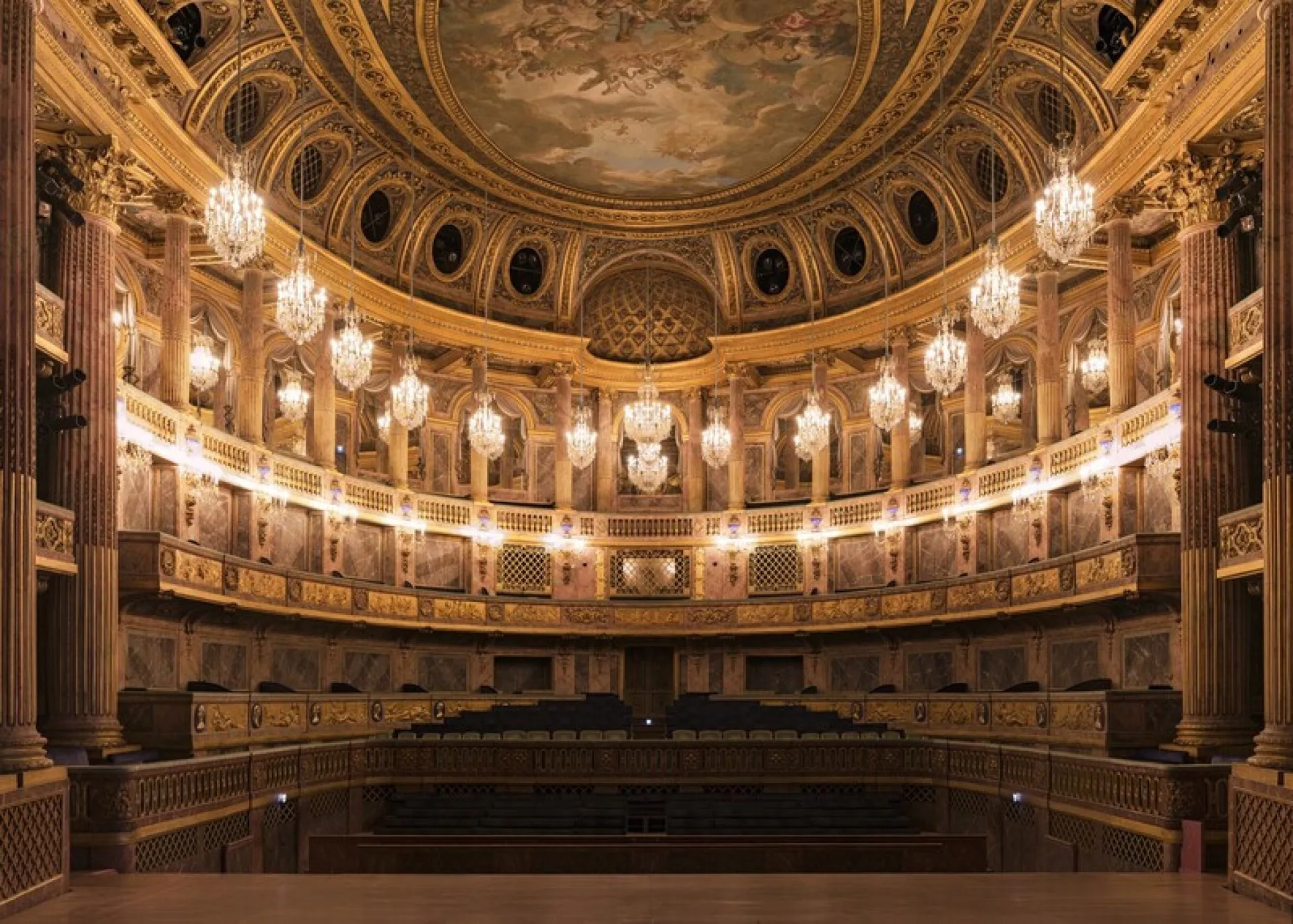
Palace of Versailles Opera Theater

Royal Opera


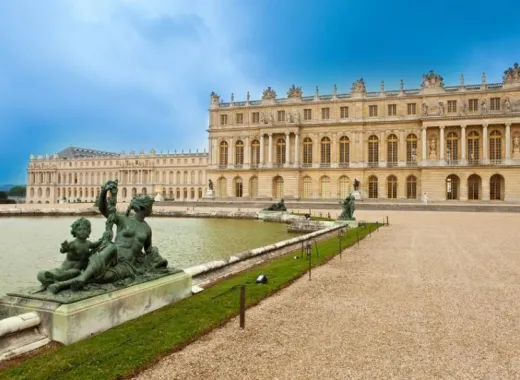
The Royal Opera of Versailles, located in the grounds of the Castle, one of the major opera houses.

The opening of the opera house at Versailles brought to a close a process of planning, projects and designs that had lasted for nearly a century. While the Royal Opera was finally built towards the end of the reign of Louis XV, it had been envisaged since as early as 1682, the year when his predecessor Louis XIV took up residence at Versailles. The King had commissioned Jules Hardouin-Mansart and Vigarani to draw up plans for a ballet theatre. Mansart shrewdly decided on a position at the far end of the new wing that was to be built over the coming years: the nearby reservoirs for the gardens’ fountains could be used to fight any fire that might break out, while the sloping ground on that part of the site would allow provision of the necessary technical spaces below the stage without major excavation work. So cleverly-chosen, indeed, was the planned location that none of Mansart’s successors ever questioned it.

Major building work was already under way in 1685, but was soon interrupted because of the wars and financial difficulties which beset the later part of the king’s reign. Louis XV in his turn was long put off by the huge expense involved in the project. As a result, for almost a century the French court was forced to put up with a makeshift theatre installed below the Passage des Princes. When a grand opera was required, with a large cast and complicated stage machinery, a temporary theatre would be built in the stables of the Grande Ecurie, with the entire structure being demolished once the performances were over. This temporary solution was adopted, for instance, during the celebrations of the Dauphin’s wedding in February 1745, but its inconvenience was so starkly obvious that Louis XV finally resolved to build a permanent theatre, entrusting its design to his first architect, Ange­Jacques Gabriel.

The process of actually building the new theatre, however, was to take over twenty years. During this lengthy period of construction Gabriel, who had studied the leading theatres of Italy, in particular Vicenza, Bologna, Parma, Modena and Turin, presented a series of different designs to his royal patron, none of which was accepted. Only in 1768, faced with the forthcoming successive marriages of his grandchildren, did the king finally give the order for work to commence. Building progressed steadily and the new opera house was completed in twenty-three months, ready for its inauguration on the 16th of May 1770, the day of the Dauphin’s marriage to the Archduchess Marie-Antoinette, with a performance of Persée by Quinault and Lully.
 

Royal Chapel
 

This extraordinary two-level palatine chapel was built by Jules Hardouin Mansart between 1699 and 1708 and completed by Robert de Cotte in 1710.
The paintings on the vaulted ceiling by Antoine Coypel, Charles de la Fosse and Jean Jouvenet, as well as the lavish decoration fashioned by a team of sculptors working for Louis XIV, depict a number of Old and New Testament scenes. Facing the royal gallery is the remarkable organ, created by Robert Clicquot, the King's organ builder, which was first played on Easter Sunday 1711 by François Couperin.
Even though Hardouin-Mansart did not witness the completion of the chapel, he was the one who had dictated the major aspects of the architecture and decor: a ground floor with a nave, aisles and ambulatory, and an upper floor with galleries, a harmonious combination of white and gold contrasting with the polychromatic marble floor and paintings on the vaulted ceiling, all combining to create an original space with references to both gothic architecture and baroque aesthetics.
Every day, generally at 10 a.m., the court would attend the King's mass. The King would sit in the royal gallery, surrounded by his family, while the ladies of the court would occupy the side galleries. The "officers" and the public would sit in the nave. The King would only descend to the ground floor for important religious festivals when he would take communion, for Order of the Holy Spirit ceremonies and for the baptisms and weddings of the Children of France, which were celebrated there between 1710 and 1789. Above the altar, around the Cliquot organ played by the greatest virtuosos of their age, including François Couperin, the Chapel Choir, renowned throughout Europe, would sing motets throughout the entire service, every day.

The Orangerie gardens
 

From May to October, orange trees and other shrubs are taken out of the Parterre Bas of the Orangerie gardens. At the center of this parterre, there is a large circular pool surrounded by six sections of lawn.


Orangerie
 

A great stone cathedral within a formal garden, The Orangerie is both a royal and magical place.

Built between 1684 and 1686 by Jules Hardouin-Mansart to house and protect precious trees and shrubs during the Winter, this extraordinarily large building is located beneath the parterre du Midi (South flowerbed), for which it acts as a support. Two monumental staircases, known as "les Cent Marches" (the hundred steps), frame the Orangerie's three galleries, which overlook the parterre where, during the Summer, more than 1,200 exotic trees are arranged.


Related events