
 EN
EN DE
DE IT
IT FR
FR ES
ES RU
RU JP
JP RO
RO
© Sebastien Mathe / Onp
Rituals
Order tickets
 October 2027 October 2027 | ||||||
|---|---|---|---|---|---|---|
Mo | Tu | We | Th | Fr | Sa | Su |
Rituals l Ballet
The Premium Category offers an exclusive experience, including:
The best available seats within the Optima Category
A contribution in support of the Opera
A program of the event
A glass of champagne
Synopsis
Serge Lifar, who died 40 years ago, distilled his neoclassical art in Suite en blanc (1943). This work of “pure dance” has become almost a ritual for the Paris Opera Ballet, paying tribute to the French school while continuing to inspire it over time.
A musical score provides a uniquely potent impulse for choreographic invention. The hypnotic music of Ravel’s Boléro inspired Shahar Binyamini, a choreographer trained at the Batsheva Dance Company, to create a physical and frenetic ballet that is now entering the Paris Opera’s repertoire.
Seizing on the revolutionary rhythms of Stravinsky’s The Rite of Spring, Pina Bausch created a visceral, highly emotional piece in 1975, where the Chosen One’s blood-red dress and her earth-stained skin, emerging from the chorus of dancers, evoke a primitive ritual and transcend the audience.
Program and cast
Duration : 2h25 with 2 intervals
First part: 40 min
Intermission: 20 min
Second part: 20 min
Intermission: 30 min
Third part: 35 min
Suite en blanc
Creative team
Serge Lifar: Choreography
Édouard Lalo: Music(1823-1892)
Vello Pähn: Conductor
Boléro X
Creative Team
Shahar Binyamini: Choreographyset, costume and lighting design
Maurice Ravel: Music(1875-1937)
Vello Pähn: Conductor
Ofer Laufer: Lighting design
Le Sacre du printemps
Creative Team
Pina Bausch: Choreography
Igor Stravinsky: Music(1882-1971)
Vello Pähn: Conductor
Rolf Borzik: Scenography, costume and lighting design
The Paris Opera Étoiles, First Soloists and Corps de Ballet
The Paris Opera Orchestra
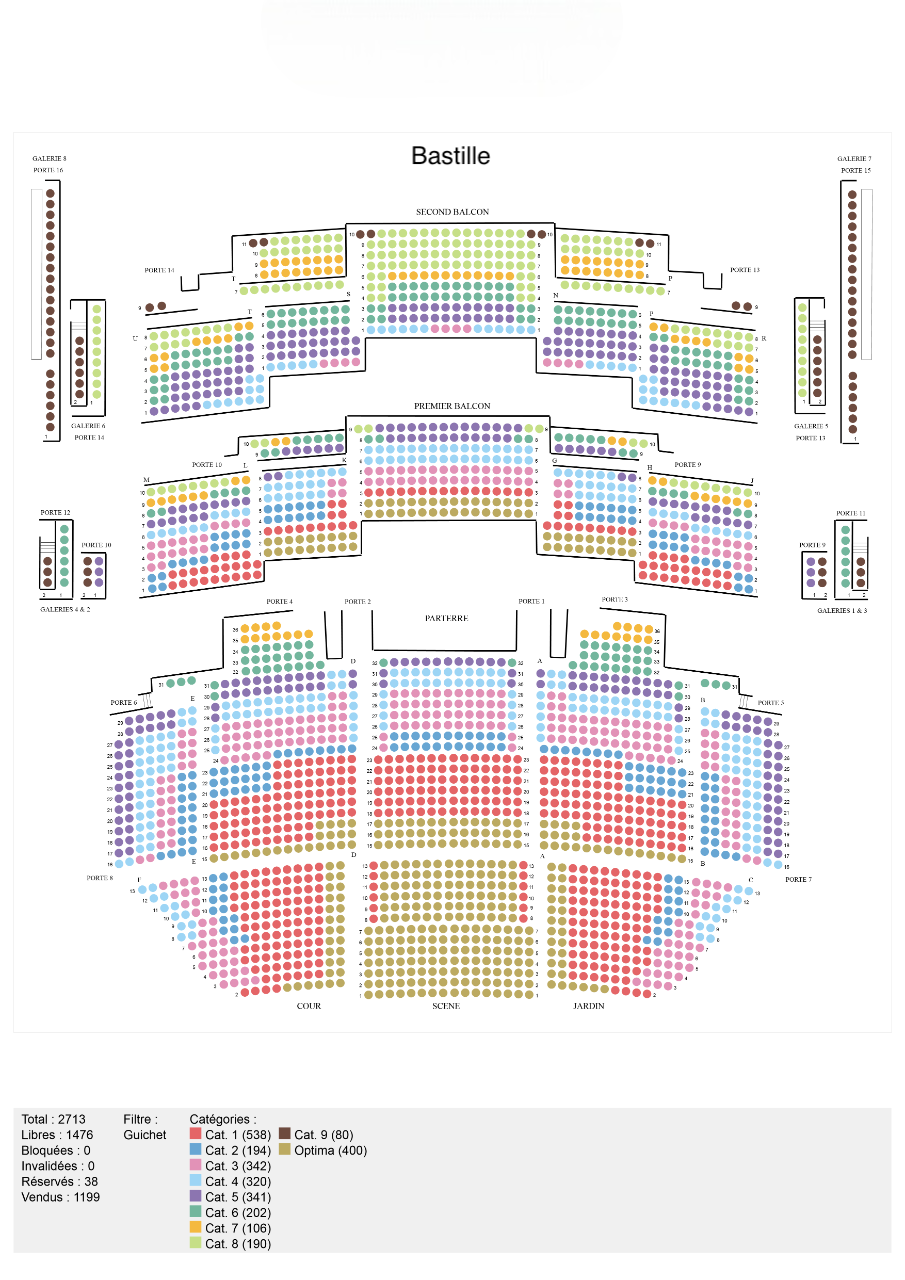
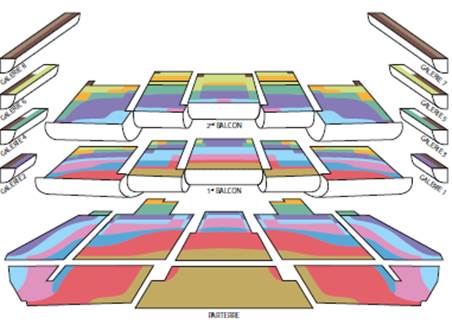
Paris Opera Bastille
RM Europa Ticket GmbH is an officially accredited ticket reseller of/by Opera National de Paris.
Agency number: 4848428
Opéra Bastille
A great modern theatre
The Opéra Bastille is the work of the Canadian-Uruguayan architect Carlos Ott, who was chosen in November 1983 after an international competition that attracted entries from some 1,700 architects. The theatre was inaugurated on July 13th 1989.
Its architecture is marked by transparent façades and by the use of identical materials for both the interiors and the exteriors.
With its 2,700 acoustically consistent seats, its unique stage facilities, its integrated scenery, costume and accessory workshops, as well as its numerous work areas and rehearsal rooms, the Opera Bastille is a great modern theatre.
Stage facilities
Orchestra pit, mobile and adjustable, can be covered; at its largest it can house 130 musicians
Main stage, 45 m high, 30 m wide, 25 m deep, made up of 9 elevators allowing several levels to be created and supported by three main elevators, which bring scenery up from below stage
Clearing zones, 4 storage areas with the same dimensions as the stage
Backstage area, with its scenery turntable
Circulation area, scenery temporarily stored between the stage, workshops and rehearsal stage
Rehearsal stage, the Salle Gounod, with its orchestra pit and dimensions identical to those of the main stage
The building
Area at ground level: 22,000 m²
Floor area: 160,000 m²
Total height: 80 m (including 30 m below street level)
The auditoriums
The main auditorium
Area: 1,200 m², 5% of the total for the building
Dimensions: 20 m high, 32 m deep, 40 m wide
Number of seats: 2,703
Materials: blue granite from Lannelin in Brittany, pearwood from China, glass ceiling
The amphitheatre
Area: 700 m²
Depth : 21.4 m
Number of seats : 450
Materials: white breccia marble from Verona, staff ceiling
The Studio
Area: 280 m²
Depth: 19,5 m
Number of seats: 237
Materials: white breccia marble from Verona and pearwood

Related events